Cyclone season: the 7 IT tests to run before December
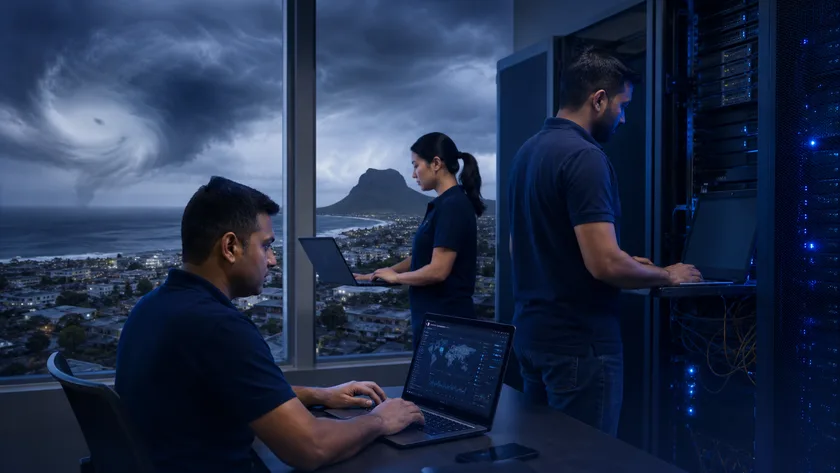
In Mauritius, cyclone season runs from November to April: class III and IV warnings, power cuts, disrupted telecoms. The only way to know whether your IT will survive it is to test it beforehand — here are the 7 tests to run before December, from the simplest to the most complete.
Why test before December, not during a warning
Every austral summer brings its share of cyclone warnings, power outages and degraded telecom links. A disaster recovery plan (DRP) you discover during a class III warning is a plan that fails: teams are at home, suppliers are overloaded, and every improvisation costs hours — and an hour of downtime has a price. In October and November, by contrast, the weather is calm, teams are available and there is still time to fix what the tests reveal.
The 7 tests, from simplest to most complete
1. Actually restore a backup
A backup only exists once it has been restored. Pick a representative server or database, restore it to an isolated environment, time the operation, check data integrity. If your backups only live on site, this test should worry you: a cyclone is a site-level disaster. (On tamper-proof copies, see our article on ransomware and backups.)
2. Check the off-site backup
Cyclones bring flooding, roof damage and long outages. A copy of your data must exist outside your building — another site or a cloud — and must be restorable independently.
3. Fail over to the recovery site
If you have a recovery site or standby infrastructure, run a real failover of at least one critical service. Not a paper exercise: an actual switchover, with users confirming they can work.
4. Measure your real RTO
Time the full recovery: detection, decision, failover, verification. The number you get is your real RTO — compare it with what management believes it is. The gap is usually instructive.
5. Test power autonomy
UPS units: how many real minutes do they hold? Generator: does it start under load? Is there fuel? Who knows how to start it on a Sunday?
6. Walk the alert chain and the on-call rota
Simulate an incident outside business hours: who gets alerted, through which channel, how fast? Are the phone numbers up to date? If everything rests on one person, you have a single point of failure.
7. Work for one hour in degraded mode
Deliberately cut access to one critical service for an hour and observe: are there paper procedures? Is the documentation available offline? How does the team communicate if IP telephony goes down? (This test also covers the international connectivity scenario — see the plan B for a cut submarine cable.)
What a first test almost always reveals
Outdated documentation, forgotten dependencies, passwords living in one person's head, a real RTO far above the assumed one. That is normal: the whole point of testing is to find these gaps in October rather than in January. It is also the value of monitoring and on-call under SLA as SOVALYX operates them: someone is watching, even on 25 December.
Recap: your test plan before the season
| Test | Question it answers | When |
|---|---|---|
| 1. Backup restore | Can we recover the data? | October, then every quarter |
| 2. Off-site backup | Do we survive a site-level disaster? | October |
| 3. Failover to recovery site | Does the DR plan really work? | November |
| 4. Measured RTO | How much real downtime? | November |
| 5. Power autonomy | Can we ride out a long outage? | October-November |
| 6. Alert chain | Does on-call answer at night? | November |
| 7. Degraded mode | Can we work without the system? | November |
Seven tests, two months. If even one fails, better to know now — talk to a specialist before the first warnings.
How SOVALYX can help
If even one of these seven tests worries you, SOVALYX can start with an infrastructure diagnostic to identify what would not survive a site-wide disaster. Our private cloud hosted in Mauritius acts as your recovery site with an automated disaster recovery plan, and the failover is genuinely tested with you — timed RTO, written report — before each cyclone season. And during a warning, 24/7 supervision under SLA means someone is watching and triggering the on-call chain, even on a Sunday in December.
Talk disaster recovery with an engineer🧰 The companion tool: Would your IT survive a cyclone? — free · 2 minutes.
Reviewed and optimised by AI.