Submarine cables: a digital plan B for Mauritian businesses
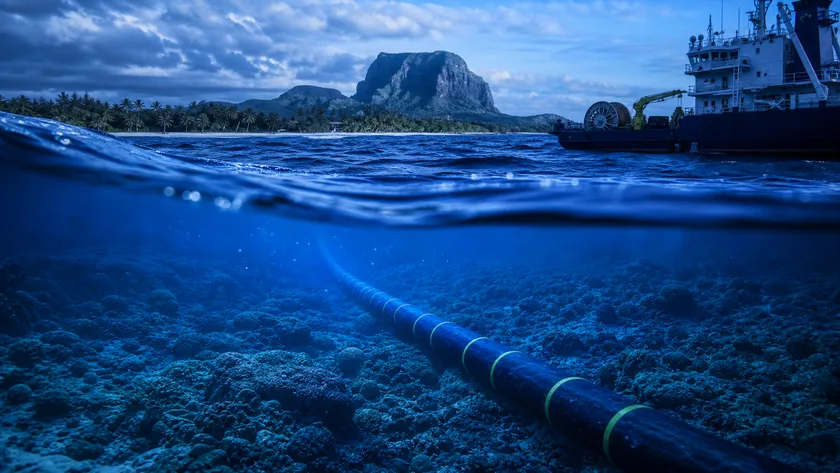
Mauritius is connected to the world by a handful of submarine cables — SAFE, LION, METISS, T3, IOX. When one of them is damaged, traffic shifts to the others, capacity shrinks and services hosted abroad slow down or become unreachable. A digital plan B is built before the incident, not during it.
One island, a handful of cables
Like any island, Mauritius depends on its submarine links for the bulk of its international connectivity: SAFE, LION, METISS, T3 and IOX form the core of that mesh. It is genuine redundancy — several cables, several landing points — but finite redundancy: every regional cable incident rightly reignites the debate about the island's connectivity resilience.
Repairing a submarine cable is anything but instant: the break must be located, a specialised cable ship mobilised, then the repair carried out at sea — a process measured in weeks rather than hours. In the meantime, the affected cable's traffic shifts onto the remaining links.
What actually happens to your business
A cable cut almost never means "no internet at all". The realistic scenario is more insidious:
- international capacity drops: the remaining links absorb the traffic, with congestion at peak hours;
- latency rises: traffic takes longer routes;
- services hosted abroad degrade first: video conferencing, SaaS, off-island backups.
In other words: your local connection works, your colleagues are in the office, but your CRM hosted in Europe crawls and your IP telephony keeps dropping. If your entire IT lives abroad, a cable outage looks very much like a cloud outage — the 4 questions to ask before the next cloud outage apply word for word.
Plan B is about more than servers
1. Multi-path connectivity. Two links from the same operator running through the same duct — or the same submarine cable — are not redundancy. Combine two operators, check the physical paths, add a 4G/5G backup for essential uses, and ask your providers the question nobody asks: "which cables does my international traffic actually ride on?"
2. Critical services usable locally. List what absolutely must keep working to invoice, pay salaries and produce. Every service on that list hosted only abroad is a dependency on a cable. The reasoning meets the sovereignty question: which data — and which services — should never depend on the outside?
3. Documented degraded modes. What does the sales team do if the CRM is unreachable for two days? A written, known and tested degraded mode (manual procedure, local file, prioritisation of the remaining bandwidth) beats improvising in the middle of congestion.
Hosting locally: what keeps working
When international connectivity degrades, everything hosted on the island for Mauritian users keeps working: local traffic does not ride the international cables. That is one of the concrete arguments for a local private cloud — along with data control and close-at-hand SLAs (see private cloud, disaster recovery and monitoring under SLA). At SOVALYX, this "isolated island" scenario is one of the cases rehearsed in DR plans: the question is not only "where are your servers?", but "what can your teams still do when international links go down?"
Checklist: assess your dependence on international links
- List your 10 critical applications and note where each is hosted (island, Europe, elsewhere).
- For each application hosted abroad, answer: usable in degraded mode? local alternative?
- Check that your two operator links share neither the same physical path nor the same cable.
- Set up a backup access (4G/5G, second ISP) that has been tested — not just signed for.
- Keep a local copy of the data and documents needed to invoice, pay and produce.
- Document a degraded mode per critical service and rehearse it during your pre-cyclone-season DR test.
How SOVALYX can help
To reduce your dependence on international cables, SOVALYX starts with an infrastructure diagnostic: which critical applications live abroad, and what would still work if international links degraded. A private cloud hosted in Mauritius keeps your essential services reachable by your local teams even when international connectivity falters, and the isolated-island scenario is one of the cases our automated, tested disaster recovery plans cover. 24/7 supervision under SLA spots the degradation within minutes, before your users feel it.
Talk disaster recovery with an engineer🧰 The companion tool: What does one hour of downtime cost you? — free · 2 minutes.
Reviewed and optimised by AI.