Power cuts: protecting your IT in Mauritius
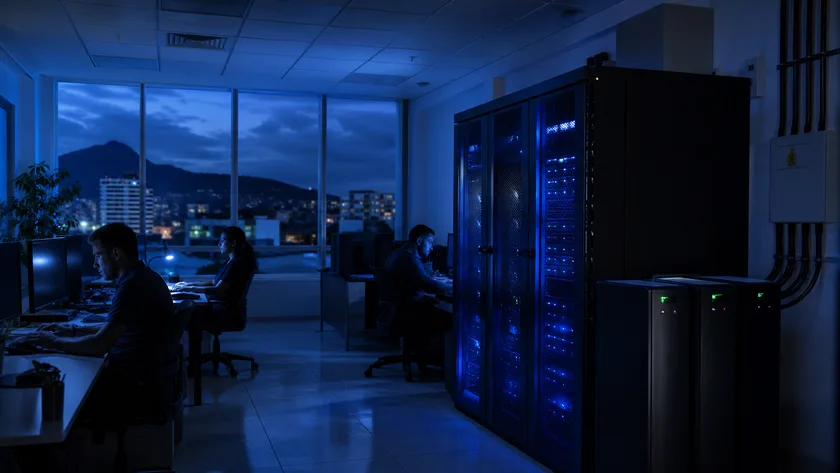
On an island power grid, the question is not whether an outage will happen, but when — and whether your IT will shut down cleanly or mid-disk-write. The answer comes in four layers: a properly sized UPS, an automated clean shutdown, a generator to last, and failover to a backup site when the first three are no longer enough.
Why the island context changes the equation
The Mauritian power grid is an island grid: isolated, with no interconnection to a continental neighbour able to take over. Every hazard — a cyclone, torrential rain, works on a line, an incident at a substation — has to be handled with local resources alone. Add cyclone season, which concentrates its share of downed lines and preventive load shedding every austral summer.
But it would be a mistake to think only about major outages. Micro-cuts and voltage fluctuations — too brief to notice except as flickering lights — wear out power supplies, corrupt disk writes and restart equipment without warning. For a server or a storage array, unstable power is a permanent assault, not an exceptional event.
The UPS: the first line — if you size it properly
Not all UPS units are equal. For workstations, a line-interactive model is enough. For servers and storage, an online double-conversion UPS is the right choice: it continuously regenerates clean power instead of merely switching to battery, which also protects against the voltage fluctuations mentioned above.
Sizing must be based on the actual measured load, not on the sum of theoretical nameplate ratings. And the autonomy target must be realistic: a UPS exists to hold for a few minutes — long enough for the generator to start or the clean shutdown to run — not for hours. Two points are systematically forgotten: batteries age and must be tested on a schedule (a theoretical ten minutes of autonomy can melt away after a few years of tropical heat), and network equipment — switches, router, fibre termination — must be protected too, because a server that is alive without a network is useless.
Automated clean shutdown: the reflex that saves your data
The real value of a UPS is not holding on, but buying the time to shut down cleanly — and nobody will be standing in front of the rack at 3 a.m. to do it by hand. Shutdown must be automated: the UPS reports the outage and the battery level, and an agent orchestrates the sequence in the right order — virtual machines first, databases closed cleanly, then hypervisors, then storage last.
The restart deserves the same care: the reverse order, documented, with the checks to run before reopening the service. And every power event — switch to battery, mains return, low battery — must feed into 24/7 monitoring: a micro-cut at 2 a.m. that leaves a server down must not be discovered at 8 a.m. by the users.
Generator and backup site: lasting, then failing over
When the outage outlasts the batteries, two strategies complement each other. The generator takes over to keep running on site: it requires an automatic transfer switch (ATS) correctly wired, fuel management, and above all a regular load test — a generator that has not started in a year is an assumption, not a protection. Maintenance, ventilation and neighbourhood constraints belong in the file from day one.
For genuinely critical services, failover to a backup site — typically a private cloud hosted in a data centre with its own redundant power chain — remains the structural answer: it also protects against fire, water damage or theft, which a generator does not cover. That failover must be decided cold: what outage duration triggers it, who decides, who executes. Those thresholds are exactly your RTO and RPO, and testing them for real is part of the pre-cyclone-season preparations.
The four layers in one table
| Layer | Role | Watch out for |
|---|---|---|
| UPS | Absorb micro-cuts and fluctuations, hold for a few minutes | Size on measured load; test and replace batteries; protect network gear too |
| Automated clean shutdown | Power down in the right order without human intervention | Sequence tested in real conditions; documented restart procedure |
| Generator | Keep running beyond battery autonomy | ATS, managed fuel, regular load test, maintenance contract |
| Backup site | Keep the business running if the main site is down | Failover thresholds decided in advance; full test before cyclone season |
If you do not know which of these layers is your weak link, an assessment takes a single visit: let's talk about your setup before the next outage, not after.
How SOVALYX can help
SOVALYX hosts its clients' critical workloads on a private cloud in Mauritius backed by a redundant power chain — UPS units, a load-tested generator, 24/7 monitoring of power events — and sets up automated clean shutdown and failover to a backup site for the equipment that stays on your premises. Cyclone season is prepared before December, not during the warning.
Talk disaster recovery with an engineer🧰 The companion tool: What does one hour of downtime cost you? — free · 2 minutes.
Reviewed and optimised by AI.