Applying the 3-2-1 backup rule in a Mauritian SME
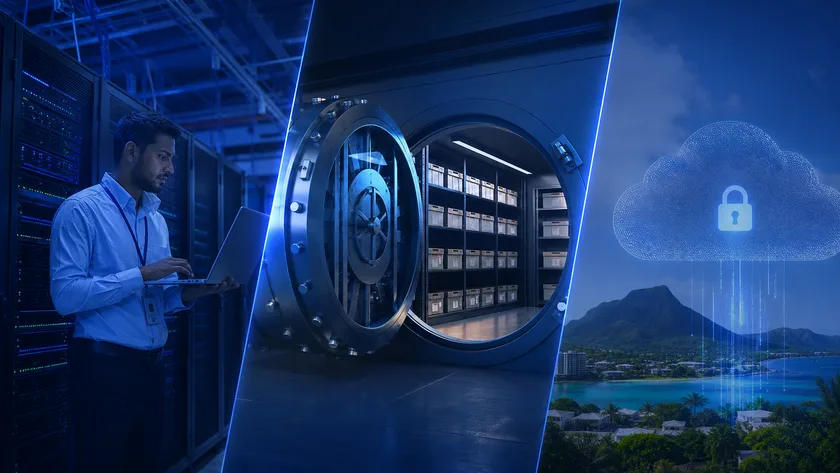
Three copies of your data, on two different types of media, one of them off-site: the 3-2-1 rule remains the simplest, most robust standard for business backups. In Mauritius it runs into a very concrete question — where do you put the off-site copy when you live on a cyclone-exposed island? — and it needs two additions that have become indispensable: immutability and restore testing.
The 3-2-1 rule in one minute
Originally coined for digital photography and since adopted as a reference by cybersecurity agencies, the rule fits in three numbers: keep three copies of any important data (the production version plus two backups), on two different types of media, with one copy off-site. Its strength is that it assumes no particular technology: it reasons in failure modes. Each requirement eliminates a family of disasters — human error, hardware failure, physical loss.
Three copies: synchronisation is not a backup
The most widespread misunderstanding in SMEs: believing that syncing to OneDrive, Google Drive or Dropbox counts as a backup. Synchronisation faithfully propagates everything — including the accidental deletion, the file encrypted by ransomware, an employee's mistake. Minutes later, the "copy" is exactly as damaged as the original.
A real backup is a frozen snapshot, taken at regular intervals, kept with version history and restorable independently of the source system. Count your copies by that criterion: many businesses that believe they have three actually have one and a half.
Two media: don't put every egg in the same failure mode
Two different media means two technologies whose failures are independent: a local NAS and remote object storage, disk and tape, a backup server and a cloud repository. If your three copies live on three disks in the same array, bought the same day from the same supplier, you do not have two media — you have the same risk three times. The test is simple: what single event could destroy both media at once? If one exists, separate further.
One copy off-site… on an island?
Off-site means, first of all, outside your premises. Against fire, water damage, theft or vandalism, a copy in a data centre on the other side of the island does the job perfectly. A major cyclone, however, crosses the whole island — and the risk becomes shared between both sites again.
The answer is not necessarily to ship your data abroad, with the applicable-law and transfer questions that raises. A data centre engineered for cyclonic conditions — reinforced building, backed-up power, redundant links — withstands wind and rain far better than an ordinary company office: what a cyclone mostly threatens is the electricity and connectivity of unprepared sites. For the most critical data, a fourth copy abroad, encrypted under your own keys, can complement the setup without replacing it. We cover this seasonal preparation in our article on disaster recovery through cyclone season.
What 3-2-1 doesn't say: immutability and restore testing
The rule predates the ransomware era. An attacker who gains administrative rights will go for your backups first — all three copies, if they can. Hence the modern requirement of an immutable backup: at least one copy that, once written, can be neither modified nor deleted for a defined period, even with administrator rights. That is the point of the 3-2-1-1-0 variant: one immutable or offline copy, and zero errors in restore testing.
Because a backup that has never been restored is an assumption, not a protection. Test full restores — not a single file: an entire server, a database, stopwatch in hand. The measured time is your real RTO, and it almost always surprises; our RTO/RPO guide explains how to set those targets. In Mauritius, an immutable repository hosted on a local private cloud — such as the one SOVALYX operates — provides the off-site copy without sending your data off the island.
Your SME's 3-2-1 checklist
- Inventory the vital data: files, databases, email, configurations.
- Count real copies: synchronisation does not count.
- Check the media: two technologies with independent failure modes.
- Get one copy off-site, outside your premises and outside your network.
- Enable immutability on at least one backup repository.
- Isolate access: backup credentials separate from the directory, with MFA.
- Test a full restore and note the duration: that is your measured RTO.
- Schedule the test before cyclone season, then at regular intervals.
- Document who restores what, in what order, with which keys.
- Have the setup audited once a year — an outside eye spots in an hour the gaps you no longer see.
How SOVALYX can help
SOVALYX hosts immutable backup repositories on its private cloud in Mauritius, outside its clients' networks: the off-site copy of your 3-2-1 without sending data off the island. Restorations are tested regularly and timed, so your RTO is a measured number rather than an assumption. A quick assessment shows where your current setup drifts from the rule.
Talk disaster recovery with an engineer🧰 The companion tool: What does one hour of downtime cost you? — free · 2 minutes.
Reviewed and optimised by AI.